
Your Bot is a Bi$*%
Is Your AI-Powered Customer Service Bot Costing You More Than It Saves?
TECHNOLOGY


Whether I am placing a phone call to my bank or visiting the website of my favorite vacation spot, the first interactions with customer service are guaranteed to involve a bot. QuikTrip even had a bot mopping the floor the other day when I visited! I found myself saying "Oh, sorry!" and "Excuse me, sorry!" as I impeded the bot's path or tiptoed on the bot's freshly-mopped floors. I have to admit though...QuikBot was kind of cute.
Introduction: The Pitfalls of AI Customer Service B
The emergence of AI-powered customer service bots has dramatically transformed how businesses interact with their clients. These intelligent systems promise significant cost savings and the efficiency to handle a high volume of inquiries among the key attractions of implementing such technology. With the constant push for improved customer experiences, AI bots have been touted as solutions that can provide 24/7 support, ensuring that customer needs are met at any hour. Businesses are drawn to the idea of automating basic inquiries and processes, potentially reallocating human resources to more complex tasks.
However, despite the enticing advantages, the proliferation of AI customer service bots is not without its shortcomings. One of the most critical concerns is the limitations in the bot's ability to handle more intricate customer inquiries. While these bots can efficiently manage straightforward questions and repetitive tasks, they often struggle with issues that require nuanced understanding, empathy, or problem-solving. This can result in a frustrating experience for customers when their concerns are not adequately addressed, ultimately leading to dissatisfaction and loss of business.
Furthermore, reliance on these AI systems can create a false sense of security for companies regarding customer service standards. As businesses prioritize quick and cost-effective solutions, the possible negative impact on customer satisfaction and loyalty may not be fully recognized until it is too late. Investing in advanced AI technology without considering its limitations can lead to unintended consequences, highlighting the importance of balancing automation with the human touch in customer service.
A Real-Life Scenario: The Bot That Ruined My Purchase
Not long ago, I decided to switch my website's hosting platform to take advantage of a promotion. I had received an enticing coupon but, during the process, I encountered an expired code when attempting to apply it. Given the urgency of the situation, I turned to the customer service bot that had been integrated into the company’s website. Initially, I hoped this AI-powered solution would quickly resolve my issue, but I soon realized the reality was far from that.
The interaction began with a series of predetermined prompts designed to guide me through common queries. However, as I navigated this rigid framework, it became increasingly apparent that my specific concern regarding the expired coupon was outside the bot's capabilities. I attempted to express my need for assistance from a human representative, but the AI persistently deflected my requests. Each time I typed "connect me to a human" or "speak of a live agent," my plea was met with scripted responses that offered no real solution, only redirecting me to the same robotic dialogue. I found myself literally yelling, "CUS-TO-MER SER-VICE" and "REP-RE-SEN-TA-TIVE," to no avail.
The impersonal nature of the bot exacerbated my frustration; there was a clear absence of empathy that I expected when dealing with customer service. Rather than feeling supported in resolving my hosting concerns, I felt trapped in an unyielding shell of automation that failed to recognize my predicament. This inflexible interaction not only wasted precious time but ultimately encouraged me to abandon my significant purchase altogether, leading to a loss for both myself and the company. Rather than saving costs with an AI bot, this experience illuminated how the reliance on such technology can result in lost customers and revenue due to its inability to address more complex issues effectively.
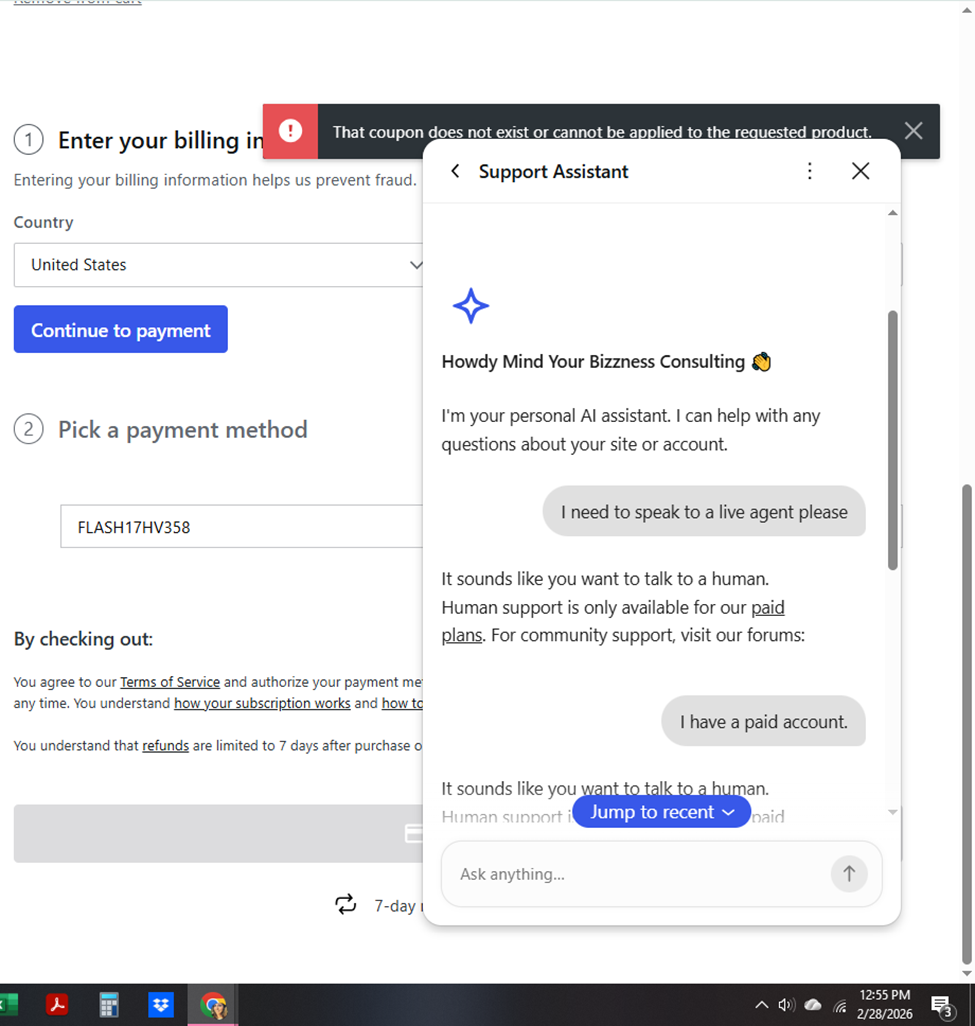
Now, to be fair... the coupon I had was expired. Expired by 12 hours. But either way you cut it, expired.
On the flip side, however, my cart subtotal was over a thousand dollars, included the transfer of 10+ domains, and I was willing to pay the annual amount at checkout.
Hence why I needed the coupon.
Analyzing the Impact: How Bots Can Affect Your Bottom Line
As businesses increasingly adopt AI-powered customer service bots, it is vital to understand the broader implications of this reliance. While cost-saving benefits are often touted, there can be significant downsides that ultimately cause more harm than good to a company’s bottom line. One of the primary issues lies in customer frustration when interacting with these bots. Studies have shown that a notable percentage of consumers prefer human interactions, particularly in sensitive or complex situations. This preference can lead to dissatisfaction when customers feel that their needs are not being adequately met.
According to research, 75% of people express frustration with bots when they are unable to resolve issues. Such negative experiences can result in lost sales; customers who feel unsupported are less likely to return for future transactions. Additionally, there is a substantial impact on customer loyalty stemming from these experiences. A single negative interaction with a bot can dissuade customers from recommending a brand to others, which further compounds the financial implications.
Moreover, not all demographics are equally comfortable with technology. For instance, older customers may find AI bots less intuitive and more frustrating compared to younger tech-savvy users. If businesses fail to cater to these specific user demographics, they risk alienating a significant portion of their customer base. This demographic disparity highlights the shortcomings of a one-size-fits-all approach in customer service. It becomes evident that while AI bots can enhance efficiency, they must be deployed thoughtfully, considering their potential negative effects on brand reputation and customer experience.
Finding a Balance: Integrating Human Touch with AI Efficiency
As businesses increasingly turn to AI-powered customer service bots to streamline operations and reduce costs, it becomes essential to recognize the limitations of these automated systems. Striking a balance between the efficiency of AI and the irreplaceable human touch can significantly enhance customer satisfaction. One effective strategy is to ensure that customers have seamless access to human representatives. This can be achieved by implementing a tiered system where AI handles preliminary inquiries and directs customers to a human agent if the issue remains unresolved or if the customer's tone indicates frustration.
Furthermore, maintaining a personal touch in automated interactions is critical. This can be achieved through personalization techniques within the AI framework, such as addressing customers by their names, utilizing past interaction histories, and tailoring responses to reflect customer preferences. Such measures can foster a sense of connection between the customer and the service provider, reducing feelings of alienation often associated with automated systems.
Another pivotal aspect of maintaining a balanced approach is the continuous monitoring and improvement of AI systems. Businesses should regularly evaluate the performance of their AI bots through customer feedback and data analytics. This practice not only helps identify pain points but also provides insights into how well the AI aligns with customer expectations. Adjustments should be made accordingly, ensuring that the AI system evolves in tandem with customer needs. By iteratively refining the capabilities of the AI, companies can enhance user experiences, thereby increasing loyalty and reducing potential customer churn.
Ultimately, while the integration of AI in customer service presents numerous benefits, it is the harmonious coexistence with human representatives that keeps the service both efficient and empathetic. Balancing these elements can lead to more satisfied customers, creating a competitive advantage in an increasingly automated marketplace.